Snoring and sleep apnea are not the same thing
Snoring is noise. Obstructive sleep apnea is repeated blockage of the airway that makes breathing stop and restart through the night, dropping oxygen levels each time. Loud snoring can be a sign of it, but plenty of people snore without having apnea, and some people with apnea barely snore at all.
Here is the part we want to be completely plain about: a dentist does not diagnose sleep apnea. Diagnosis comes from a physician, almost always on the basis of a sleep study done either in a lab or at home. If what you describe suggests apnea and you have never been tested, we will tell you so and help you get to a physician before we make you anything.
And an oral appliance does not cure sleep apnea. It manages it, on the nights you wear it, for as long as you keep wearing it. Anyone who tells you a mouthpiece cures a breathing disorder is selling something.
Signs worth raising with a physician
None of these confirm anything on their own, and several have ordinary explanations. Together they are the pattern that makes a sleep study worth doing.
- Snoring loud enough to wake a partner, or to be heard through a closed door
- Gasping, choking, or pauses in breathing that someone has actually witnessed
- Waking up unrefreshed after a full night in bed, most mornings
- Daytime sleepiness, especially nodding off while reading, in meetings, or at the wheel
- Morning headaches, a dry mouth, or a sore throat on waking
- Waking repeatedly through the night, including to use the bathroom
- Trouble concentrating, low mood, or irritability that does not have another obvious cause
- High blood pressure, particularly if it has been hard to control
The two appliances we offer
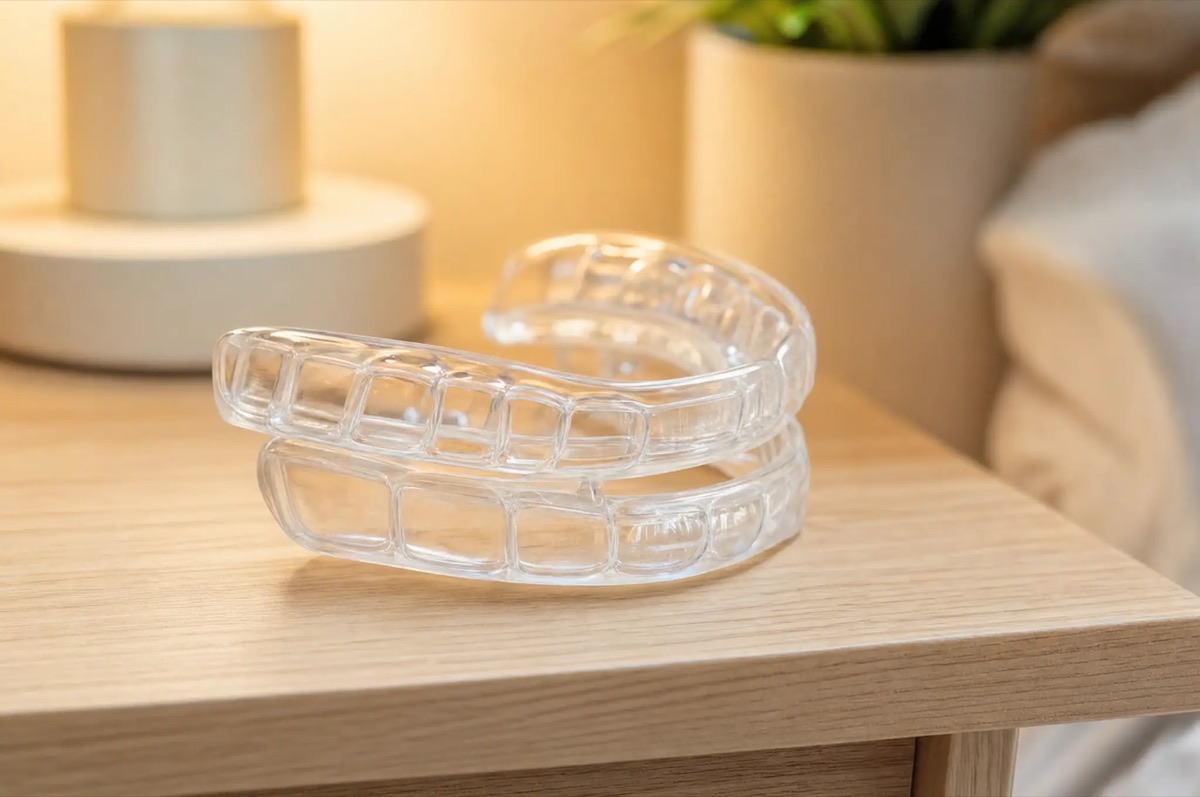
Both are mandibular advancement devices. Both are custom made from a scan or impressions of your own teeth, both are worn only at night, and both work on the same principle: hold the lower jaw and tongue slightly forward so the airway behind them stays open.
ProSomnus is milled from a solid block of medical-grade material. It is rigid, thin, holds a prescribed position precisely, and generally stands up better to heavy clenching. Silent Nite is a lighter dual-laminate design with a soft inner layer and small connectors on each side; advancement is adjusted by swapping connectors, which is quick to do chairside.
Which one suits you comes down to your jaw anatomy, how much advancement you need, the condition and amount of your existing dental work, whether you grind, and what your coverage allows. We will lay out both honestly rather than steering you to one.
What to expect
- Conversation and exam. We go through your sleep history and your partner's observations, then examine your airway, tongue, tonsils, jaw range of motion, teeth, and gums. We also ask whether you have ever had a sleep study.
- Physician first, if needed. If your history points to apnea and you have not been evaluated, we refer you out before we do anything else. That order is not optional and it is not us being cautious for its own sake.
- Records. A digital scan or impressions of both arches, plus a bite record taken with your jaw at a specific, conservative starting position. Everything is built around that measurement.
- Fitting. At a second visit we seat the appliance, check retention and comfort, and show you how to insert it, remove it, and clean it. You take it home and start sleeping in it.
- Tuning and follow-up. We advance the jaw in small increments over follow-up visits, watching both whether symptoms improve and whether your jaw and bite stay comfortable. If you have diagnosed apnea, your physician may want a repeat sleep test with the appliance in to confirm it is doing its job.
Side effects and honest limits
Common early effects are extra saliva or a dry mouth, tooth tenderness, and morning jaw soreness that usually eases within an hour or so of waking. We show you a short set of morning exercises that help the bite settle back.
Gradual changes to the bite are a recognized long-term effect of every mandibular advancement device, not a defect in a particular brand. We check your bite at every follow-up specifically so that any drift is caught early rather than discovered years later.
An appliance is not right for everyone. You need enough healthy natural teeth to anchor it, active gum disease has to be treated first, and significant jaw joint problems may rule it out or need to be managed alongside. For severe obstructive sleep apnea, CPAP remains the standard of care, and appliances are typically considered for mild to moderate cases or for people who genuinely cannot tolerate CPAP, in consultation with the physician managing your diagnosis.
Common questions
Will an oral appliance cure my sleep apnea?
No. Nothing a dentist makes cures obstructive sleep apnea. A properly fitted appliance can reduce or control the obstruction while you are wearing it, which is why it has to be worn every night and why your physician may want to retest you with it in place. Stop wearing it and the condition is exactly where it was.
Do I need a sleep study before you can make me an appliance?
If sleep apnea is suspected, yes. A dentist cannot diagnose it, and treating an undiagnosed breathing disorder with a mouthpiece can quiet the snoring while leaving the underlying problem in place. If you snore, have been evaluated, and apnea was ruled out, an appliance for simple snoring is a reasonable conversation to have.
Is oral appliance therapy covered by insurance?
When it is treating diagnosed obstructive sleep apnea it is usually billed to medical insurance rather than dental, and plans commonly want the sleep study report and a physician's order on file. Some also ask for documentation about CPAP. Coverage varies a great deal, so let our front desk find out exactly what your plan requires before anything is made.
Can I just buy a snoring mouthpiece online?
You can, and the risks are worth knowing. A boil-and-bite device is not measured to your bite, holds your jaw at an arbitrary position, and often fits loosely enough that it either falls out or pulls on teeth unevenly. Bite changes and jaw soreness are more likely, not less. It also skips the step where someone checks whether snoring is your only problem.
Does an oral appliance work for everyone who snores?
No. Results vary, and some people see partial improvement rather than silence. Snoring driven by nasal obstruction, large tonsils, alcohol before bed, or sleeping position may respond better to other measures, sometimes alongside an appliance. We will tell you honestly how likely we think it is to help in your case before you commit.
Which is better, ProSomnus or Silent Nite?
Neither is better in general; they suit different mouths. ProSomnus is more rigid and precise, which tends to favor heavy grinders and cases needing exact positioning. Silent Nite is lighter and flexible, adjusts quickly by changing connectors, and is often the more economical of the two. We choose after the exam, not before it.