
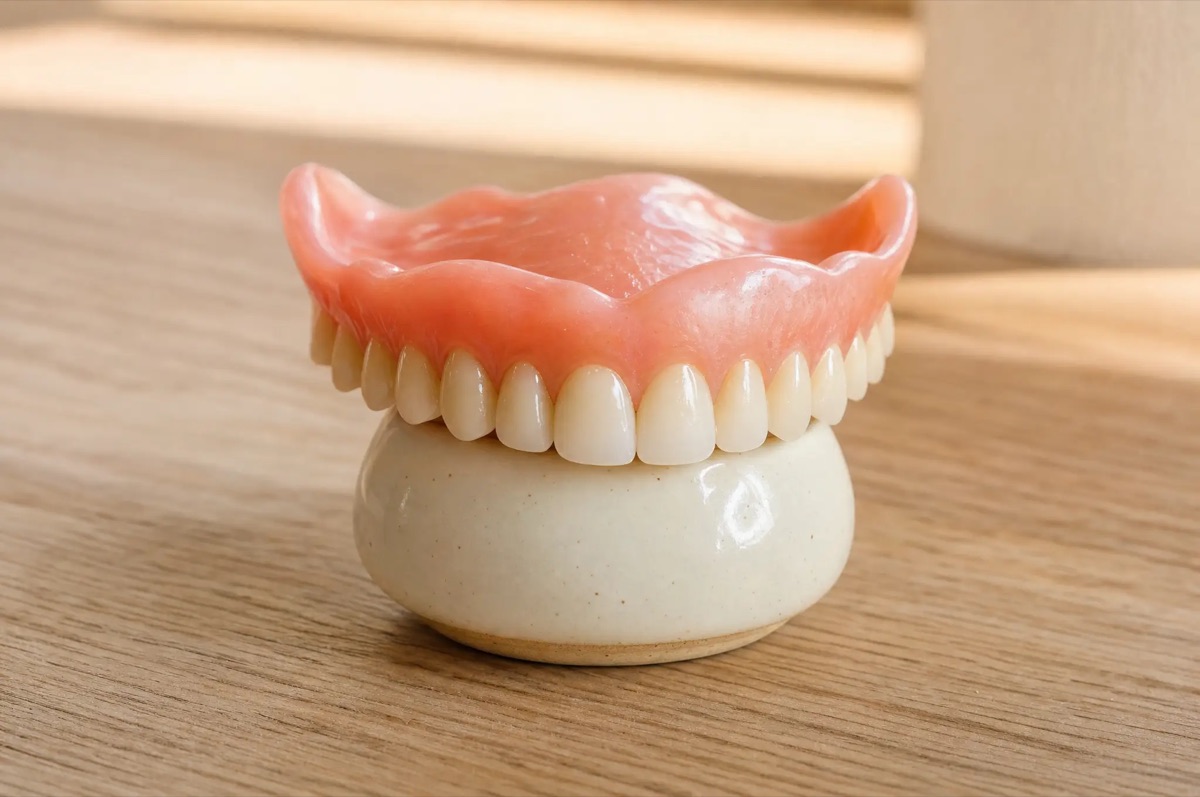
Getting function back, one decision at a time
Losing teeth changes more than appearance. Chewing gets harder, so diets narrow. Certain sounds get slippery. The lower face loses some of its support. A well-made denture addresses those things, and for many people the biggest relief is simply eating a meal without planning around it.
Every case starts with the same question: what is still there and what condition is it in? A partial preserves your natural teeth, which is almost always worth doing when those teeth are healthy, since they help anchor the appliance and preserve bone. A full denture becomes the option when an arch cannot be saved. We do not rush anyone toward extraction, and we will tell you plainly if a tooth you assumed was hopeless can actually be kept.
The main options
Cost, timeline, bone volume, and your health history all factor in. If implants interest you, we can talk through whether you are a candidate before you commit to a path.
- Full dentures, replacing all the teeth in the upper arch, the lower arch, or both
- Partial dentures, which clasp onto your remaining teeth to fill several gaps
- Immediate dentures, placed the same day teeth are removed so you are not without teeth while you heal
- Implant-supported dentures, which snap onto implants for markedly more stability, particularly on the lower arch
How we build a denture that fits
- Assessment. We examine your remaining teeth, gums, ridges, and bite, take x-rays, and discuss what you want to be able to eat and how you want it to look.
- Impressions. Detailed molds capture the shape of your ridges and tissues. Accuracy here is what separates a denture that stays put from one that does not.
- Bite records and tooth selection. We record how your jaws meet and choose tooth shape, size, and shade together.
- Try-in. You see a wax version and tell us what to change before anything is finalized. Speak with it, smile with it, be picky.
- Delivery and adjustments. We fit the finished denture and check pressure points. Follow-up adjustments are a normal part of the process, not a sign something went wrong.
The first few weeks, honestly
New dentures feel foreign at first. Most people report extra saliva, a fuller feeling, and some awkwardness with words like s and f in the early days. Reading out loud at home helps your tongue adapt faster than waiting it out. Start with soft foods cut small, chew on both sides at once to keep the denture balanced, and add harder foods gradually.
Sore spots are common and easy to fix, so call us instead of enduring them. Do not file or adjust a denture yourself. Clean it daily over a folded towel or a sink of water with a denture brush and a cleanser made for the purpose, since regular toothpaste is abrasive. Take it out at night unless we tell you otherwise, and keep brushing your gums, tongue, and any remaining teeth. Over the years your jawbone changes shape, so a denture that fit well may loosen and need a reline. That is expected, not a defect.
Common questions
How long does it take to get dentures?
A conventional denture typically takes several appointments spread over a few weeks, because each step builds on the one before it. Immediate dentures follow a different sequence. We will give you a timeline for your specific case at your first visit rather than a generic estimate.
Will dentures change how I talk?
Temporarily, for most people. Certain sounds take practice while your tongue learns the new landscape in your mouth. Speech usually settles within a few weeks, and reading aloud at home speeds that up. If a specific sound is still a problem after that, tell us, because it may point to an adjustment we can make.
Do I still need to see the dentist if I have full dentures?
Yes, and this catches people by surprise. We check the fit, look for pressure sores, examine your gums and ridges, and perform an oral cancer screening. Regular visits matter just as much when the teeth are removable.
Are partial dentures better than a bridge?
They solve overlapping problems in different ways. A partial is removable, replaces several teeth across an arch, and generally costs less. A bridge is fixed in place and usually replaces one or two teeth in a row. The number and position of missing teeth, plus the health of the neighbors, usually decide it.
Can dentures be made stronger with implants?
Yes. Implant-supported dentures attach to implants placed in the jaw, which greatly improves stability and is often life-changing for lower dentures, the ones that tend to float. Candidacy depends on your bone and your overall health, so it starts with an evaluation.