
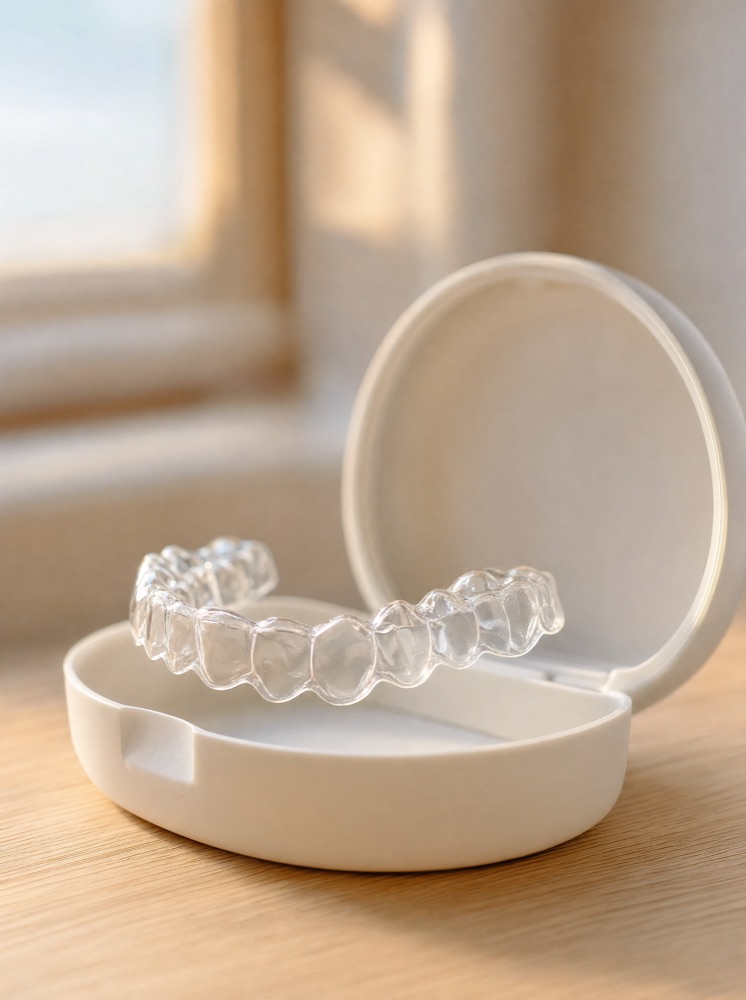
How aligner treatment works
Treatment starts with records: an exam, x-rays, photographs, and either a digital scan or impressions of your teeth. From those, a movement plan is designed for your specific bite, and a set of trays is manufactured to match each stage of that plan.
Each tray is shaped slightly differently from the position your teeth are in now. Worn consistently, it applies gentle pressure that guides the teeth toward the next step. You change to the following tray on the schedule Dr. Valter sets, and come in periodically so she can confirm the teeth are tracking the way the plan intended. Small tooth-colored bumps called attachments are sometimes bonded to certain teeth to give the tray something to grip.
Who is a candidate for clear aligner therapy?
Aligners handle a real but limited range of problems well. They are often a good fit when the concerns look like this:
- Mild to moderate crowding, where teeth overlap or twist slightly
- Gaps and spacing you would rather close
- Teeth that have drifted since you had braces years ago
- Minor bite issues that do not involve major jaw discrepancies
- Front teeth that have shifted enough to make cleaning harder
What clear aligners handle well, and what they do not
Aligners are a strong option for crowding, spacing, and mild to moderate bite concerns. They move teeth gradually and predictably, provided the trays are actually worn for the hours prescribed.
They are a weaker option for complex bite corrections, large rotations, or moving a tooth vertically. Dr. Valter will say plainly if fixed braces or a referral to an orthodontist would give you a better outcome. Starting a treatment that cannot deliver what you want helps nobody.
Aligners compared with fixed braces
The honest tradeoff is control versus convenience. Braces stay on your teeth and work whether you remember them or not, and they can manage severe rotations, significant bite corrections, and complex movements that aligners struggle with. Aligners come out for meals and brushing, they are far less noticeable, and there are no brackets to irritate your cheeks or trap food.
The catch is that aligners only work while they are in your mouth. If they sit in a pocket through lunch and dinner, treatment slows down or stops progressing. Dr. Valter will tell you plainly if she thinks your case would be better served by braces or by a referral to an orthodontist, rather than starting something that is unlikely to reach your goal.
What to expect
- Consultation and exam. Dr. Valter checks for decay and gum disease first, since teeth should not be moved through an unhealthy foundation, and discusses what you want changed.
- Records and planning. Scans or impressions, photos, and x-rays are taken, and a staged movement plan is built from them.
- Fitting your first trays. You learn how to seat and remove them, when to change to the next set, and how to clean them.
- Progress visits. Checkups are spaced several weeks apart, at intervals Dr. Valter sets based on your plan, to confirm the teeth are moving as designed.
- Retention. When active movement is finished, you move into a retainer, which is not optional if you want the result to hold.
Keeping the result
Teeth have a lifelong tendency to drift back toward where they started. That is normal biology, not a treatment failure, and it is the reason retainers exist. Wearing yours as directed is the single biggest factor in whether your teeth still look this way in five years.
Clear aligners near Bellaire, TX
Common questions
Do you offer Invisalign?
Invisalign is one brand of clear aligner. We do not carry a specific aligner brand; we provide clear aligner treatment that Dr. Valter plans, fits, and monitors in our office. If you have been researching Invisalign, the treatment steps, wear time, and results are the same category of care. Ask at your consultation and we will explain exactly what we use and why.
Are invisible braces and clear aligners the same thing?
Yes. Invisible braces, clear braces, and clear aligners all describe the same removable tray treatment. Traditional clear braces with brackets are a different, fixed option, and we cover the difference on this page under aligners compared with fixed braces.
How many hours a day do I have to wear clear aligners?
Most aligner protocols call for roughly 20 to 22 hours a day, meaning you take them out only to eat, drink anything other than water, and brush. Wear time is the main thing you control, and it has more effect on how treatment goes than almost anything else.
Can I eat with my aligners in?
No. Take them out for every meal and snack, then brush or at least rinse before putting them back in. Chewing with trays in can damage them, and food or sugary drinks trapped underneath sit against your enamel for hours.
How long does clear aligner treatment take?
Most cases run somewhere between six and eighteen months, but yours depends on how far the teeth need to move and how consistently you wear the trays. Dr. Valter gives you a realistic range after examining you, not before.
Are clear aligners suitable for teenagers?
Often yes, as long as the teenager will keep them in for the required hours each day. Aligners only work while they are in the mouth, so a teen who tends to leave them out usually does better with fixed braces. We talk that through with families honestly.
Do clear aligners work for everyone?
No, and that is worth knowing before you get attached to the idea. Severe crowding, teeth that need significant rotation, large bite discrepancies, and cases involving jaw growth are often better handled with braces or by an orthodontic specialist. Dr. Valter will give you a straight answer about your case at the consultation.
Will aligners affect how I talk?
Some people notice a slight lisp for the first few days with a new set, and it typically settles as your tongue adjusts. Talking and reading out loud at home speeds that up. It is usually far less noticeable to other people than it feels to you.
How are these different from mail-order aligners?
The main difference is in-person supervision. Treatment here begins with a clinical exam and x-rays, which is how decay, gum disease, or a root problem gets found before teeth are moved, and Dr. Valter sees you in person during treatment to confirm the teeth are actually tracking to plan. If something is not moving as designed, it gets caught and corrected.
What happens if I lose a tray?
Call or text us at (713) 668-8383 as soon as you notice. In many situations you will be asked to go back to your previous tray so the teeth do not drift while a replacement is arranged. Do not simply jump ahead to the next set on your own.